



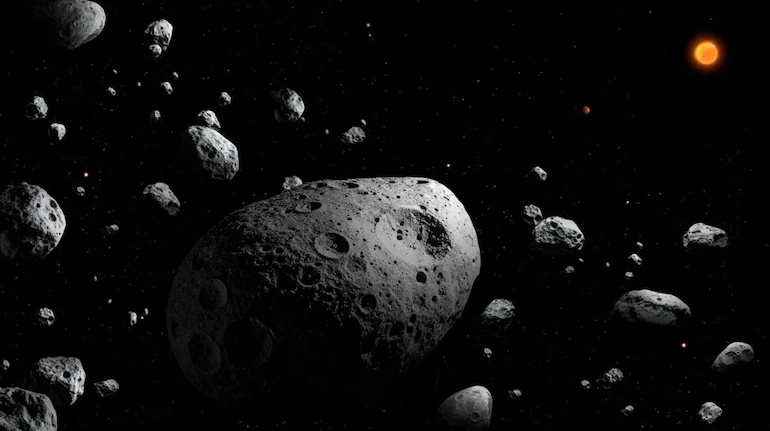
Astronomers have identified what is now believed to be the fastest‑spinning large asteroid ever observed, a discovery that is reshaping scientists’ understanding of how these rocky remnants of the early solar system behave, evolve, and survive under extreme physical stress. The finding challenges long‑standing assumptions about asteroid structure and rotation limits, and it could have important implications for planetary defense, asteroid mining, and future space missions.
A Rare and Extreme Cosmic Object
Asteroids are often imagined as slow‑tumbling chunks of rock drifting quietly through space. In reality, many rotate, wobble, and even tumble chaotically. However, most large asteroids — typically defined as those several hundred meters or more in diameter — rotate relatively slowly. This is because fast rotation should cause them to break apart due to centrifugal forces.
The newly discovered asteroid defies that expectation.
According to scientists, the object completes a full rotation in far less time than previously thought possible for an asteroid of its size. While smaller asteroids are known to spin rapidly, large bodies usually adhere to what researchers call the “spin barrier” — a theoretical limit beyond which rubble‑pile asteroids should disintegrate.
This asteroid doesn’t just cross that barrier — it smashes through it.
What Makes This Discovery So Important
For decades, astronomers have believed that most large asteroids are “rubble piles” — loose collections of rocks, dust, and debris held together mainly by gravity rather than solid internal strength. If such a body spins too quickly, centrifugal forces should overcome gravity, tearing it apart.
The newly identified asteroid’s rotation rate suggests one of two remarkable possibilities:
- It has an unexpectedly strong internal structure, possibly behaving more like a solid monolith than a rubble pile.
- It possesses hidden cohesive forces, such as electrostatic attraction or internal bonding, that allow it to stay intact despite extreme rotation.
Either explanation forces scientists to rethink how asteroids form, how they age, and how resilient they truly are.
How the Asteroid Was Found
The discovery was made using a combination of ground‑based telescopes and advanced light‑curve analysis. By measuring subtle changes in brightness as the asteroid rotated, astronomers were able to calculate its spin rate with high precision.
Every time an asteroid rotates, different portions of its surface reflect sunlight toward Earth. By tracking these brightness variations over time, scientists can reconstruct how fast the object is spinning and infer details about its shape and composition.
When researchers analyzed the data for this particular asteroid, the results immediately stood out.
“At first, we thought there must be an error,” one researcher involved in the study noted. “But repeated observations confirmed the same extraordinary rotation rate.”
Breaking the ‘Spin Barrier’
The so‑called spin barrier sits at around 2.2 hours per rotation for most large asteroids. Anything spinning faster than this is expected to break apart unless it has unusual structural properties.
The newly discovered asteroid rotates significantly faster than this threshold — a behavior that should not be possible under traditional asteroid models.
This raises fascinating questions:
- Is the asteroid made of solid rock rather than loosely bound debris?
- Did it form under unusual conditions in the early solar system?
- Could past collisions or thermal processes have altered its internal makeup?
The answers could unlock new insights into how asteroids evolve over billions of years.
What This Reveals About Asteroid Evolution
Asteroids are survivors from the chaotic early days of planet formation. Most have experienced countless collisions, temperature swings, and gravitational interactions.
A fast‑spinning large asteroid suggests that asteroid evolution is far more diverse than previously believed. Some bodies may harden internally over time, while others might be fragments of much larger parent objects that once possessed solid cores.
This discovery also hints that the population of near‑Earth and main‑belt asteroids may include more structurally robust objects than scientists assumed — a factor that could influence how we assess asteroid threats.
Implications for Planetary Defense
Understanding asteroid structure is critical for planetary defense strategies. If a potentially hazardous asteroid were on a collision course with Earth, scientists would need to know whether it is a loose rubble pile or a solid body.
A fast‑spinning, structurally strong asteroid could respond very differently to deflection attempts such as:
- Kinetic impactors
- Gravity tractors
- Nuclear deflection concepts
If an asteroid is stronger than expected, it may require entirely different mitigation approaches to safely alter its trajectory.
Relevance for Future Space Missions
The discovery could also influence future asteroid exploration and resource utilization missions.
Space agencies and private companies have shown increasing interest in:
- Asteroid mining
- Sample‑return missions
- Long‑term human exploration
A rapidly spinning asteroid presents both challenges and opportunities. Landing on or anchoring to such an object would be technically demanding, but its structural strength could make it more predictable and stable for certain operations.
A Clue to Solar System History
Scientists believe this asteroid may represent a rare evolutionary path, offering a glimpse into processes that occurred billions of years ago.
Its unusual spin could be the result of:
- Ancient collisions that compacted its interior
- Thermal forces caused by uneven solar heating
- Long‑term effects of sunlight‑driven torque, known as the YORP effect
By studying this asteroid further, researchers hope to better understand how radiation, gravity, and collisions shape small bodies across the solar system.
What Comes Next
The discovery is just the beginning. Astronomers are now planning:
- Follow‑up observations using larger telescopes
- Spectroscopic studies to determine composition
- Searches for similar fast‑spinning large asteroids in existing survey data
If more objects like this are found, it could indicate that such asteroids are not rare anomalies but rather an overlooked population.
A Reminder of How Much We Still Don’t Know
Despite decades of asteroid research, discoveries like this highlight how much remains unknown about our cosmic neighborhood. Each new finding challenges established models and forces scientists to refine their understanding of planetary formation and dynamics.
The fastest‑spinning large asteroid ever observed is not just a record‑breaker — it’s a natural laboratory that could reshape how we think about the strength, structure, and survivability of small worlds in space.
As telescopes become more powerful and sky surveys more comprehensive, scientists expect many more surprises lurking among the millions of asteroids orbiting our Sun — each with its own story to tell about the origins of the solar system and the forces that continue to shape it today.