



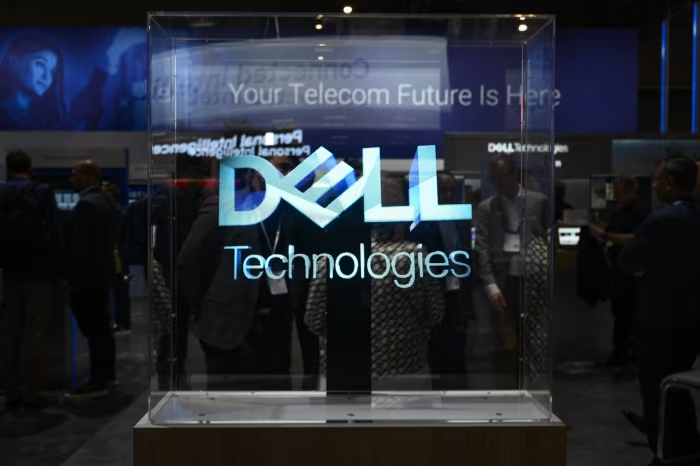
Dell Technologies has forecast a staggering $50 billion in revenue from AI-optimized servers, underscoring the explosive growth in demand for artificial intelligence infrastructure worldwide. The projection highlights how rapidly enterprises, cloud providers, and governments are investing in high-performance computing systems capable of training and deploying advanced AI models.
The announcement positions Dell as one of the key beneficiaries of the global AI boom, alongside semiconductor and cloud computing giants.
AI Infrastructure: The New Gold Rush
Artificial intelligence has shifted from experimental labs into mainstream enterprise strategy. From generative AI tools to predictive analytics and automation systems, businesses now require massive computational power to support:
- Large language model (LLM) training
- Real-time AI inference
- Data analytics at scale
- AI-driven automation and robotics
This surge in AI adoption has fueled unprecedented demand for high-performance servers equipped with advanced GPUs, high-speed networking, and optimized cooling systems.
Dell’s projected $50 billion revenue reflects long-term contracts, enterprise expansion, and hyperscale data center deployments focused specifically on AI workloads.
The Hardware Powering the AI Revolution
Dell’s AI server portfolio is built to support the most demanding machine learning and deep learning applications. Many of these systems integrate GPUs from industry leaders such as:
- NVIDIA
- AMD
These GPUs are critical for parallel processing required in AI model training.
Dell’s AI-ready infrastructure typically includes:
- High-density GPU configurations
- Advanced liquid cooling systems
- Scalable storage solutions
- High-bandwidth networking
- Optimized AI software stacks
By offering end-to-end AI infrastructure solutions, Dell caters to enterprises that want ready-to-deploy AI systems rather than building data centers from scratch.
Why AI Servers Are Driving Massive Revenue
AI workloads require significantly more computing power than traditional enterprise applications. Training a single large AI model can involve:
- Thousands of GPUs
- Petabytes of data
- Weeks or months of processing time
This makes AI infrastructure one of the fastest-growing segments in the global IT market.
Dell’s forecasted $50 billion in revenue signals:
- Large enterprise AI transformation projects
- Government investments in AI infrastructure
- Rapid expansion of cloud service providers
- Increasing adoption of private AI data centers
Companies are also opting for on-premise AI servers to maintain data privacy and regulatory compliance, further boosting demand.
Competition in the AI Server Market
Dell competes with several major players in the AI infrastructure space, including:
- Hewlett Packard Enterprise
- Lenovo
- Supermicro
However, Dell’s strong enterprise customer base, supply chain scale, and deep partnerships with chipmakers provide it with a competitive edge.
Its close collaboration with GPU manufacturers ensures priority access to high-demand AI chips, which have faced supply shortages in recent years.
Enterprise AI Adoption Accelerating
Organizations across industries are accelerating AI adoption:
Healthcare
AI models assist in diagnostics, medical imaging analysis, and patient data management.
Finance
Banks deploy AI for fraud detection, risk modeling, and automated customer service.
Manufacturing
AI-driven predictive maintenance and robotics enhance operational efficiency.
Retail & E-commerce
Personalized recommendations and demand forecasting rely heavily on AI systems.
Each of these use cases requires scalable server infrastructure — driving consistent demand for AI-optimized hardware.
Impact on Dell’s Overall Business
AI servers are quickly becoming a major growth engine for Dell. Traditionally known for PCs and enterprise IT infrastructure, Dell is now positioning itself as a leader in AI data center solutions.
The projected $50 billion revenue could:
- Boost overall profit margins
- Increase investor confidence
- Strengthen Dell’s enterprise market leadership
- Expand recurring revenue through AI services and support
AI infrastructure often includes long-term maintenance contracts and software integration services, creating ongoing revenue streams beyond hardware sales.
The Broader AI Infrastructure Boom
Dell’s forecast reflects a broader global trend: AI infrastructure spending is expected to reach hundreds of billions of dollars over the coming years.
Key drivers include:
- Generative AI expansion
- Autonomous systems development
- National AI strategies
- Data center modernization
- Cloud-to-edge AI deployment
Governments and private enterprises alike are investing heavily to secure leadership in artificial intelligence.
Challenges Ahead
Despite strong projections, the AI server market faces several challenges:
1. Chip Supply Constraints
Global demand for high-performance GPUs can strain supply chains.
2. Energy Consumption
AI data centers require enormous power and cooling resources.
3. Regulatory Concerns
AI governance and data privacy regulations may affect infrastructure deployment.
4. Economic Uncertainty
Global economic slowdowns could delay enterprise IT spending.
However, AI is widely seen as a strategic priority, meaning infrastructure investments are likely to remain resilient even during economic downturns.
What This Means for the Industry
Dell’s $50 billion AI server revenue forecast signals that AI infrastructure is no longer a niche segment — it is now central to enterprise IT strategy.
For customers, this means:
- More enterprise-ready AI solutions
- Improved performance and scalability
- Faster AI deployment cycles
- Expanded on-premise and hybrid AI options
For competitors, it intensifies the race to secure GPU supply and deliver differentiated AI hardware solutions.
Looking Ahead
As generative AI and enterprise automation continue to expand, demand for AI-optimized servers is expected to remain strong. Dell’s forecast reflects confidence that AI adoption is still in its early stages, with significant growth ahead.
The company is likely to focus on:
- Expanding AI infrastructure partnerships
- Investing in cooling and energy-efficient designs
- Enhancing AI software integration
- Strengthening global supply chains
If the $50 billion target materializes, Dell could solidify its position as a dominant force in AI infrastructure — shaping how businesses build and deploy artificial intelligence at scale.