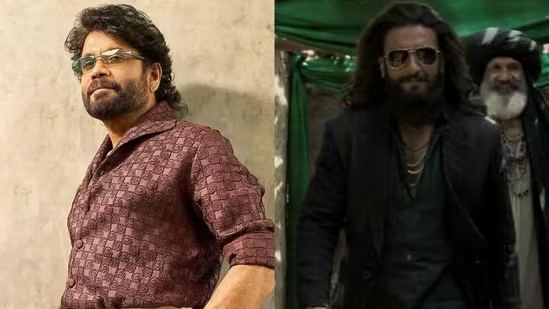





For many, birthdays are a time of celebration, reflection, and joy. But for Arjun Rampal, one particular birthday is forever marked by memories of fear, chaos, and a national tragedy that shook India to its core—the 2008 Mumbai attacks.
In a deeply emotional revelation, the actor recently opened up about witnessing the horrors of that night and how the experience stayed with him for years. He described his work in Dhurandhar as a form of “revenge”—not in a literal sense, but as a powerful emotional outlet.
This is not just a story about cinema—it’s about trauma, resilience, and how art can sometimes become a medium for healing.
A Birthday That Changed Everything
November 26, 2008, is a date etched into the memory of every Indian. What began as an ordinary evening quickly turned into a night of terror as coordinated attacks unfolded across Mumbai.
For Arjun Rampal, the tragedy struck even closer to home—it was his birthday.
Instead of celebrations, the night brought fear and uncertainty. Like many others in the city, he found himself witnessing the unfolding events in real time. The sounds, the visuals, and the emotional weight of the situation left a deep impact.
While he has rarely spoken in detail about that experience before, his recent reflections reveal how profoundly it affected him—not just as an actor, but as a human being.
The Emotional Aftermath
Experiencing or witnessing a traumatic event can leave lasting impressions, and for Rampal, the aftermath of 26/11 was not something that faded with time.
He spoke about how the memories stayed with him—the tension in the air, the helplessness, and the collective grief that followed. It wasn’t just about what happened that night, but how it changed the emotional landscape for everyone who lived through it.
For someone in the creative field, such experiences often find their way into their work, consciously or subconsciously.
Rampal admitted that a part of him carried that unresolved emotion for years, waiting for the right moment—or the right story—to express it.
Dhurandhar as an Emotional Outlet
When Dhurandhar came into his life, it offered more than just another acting opportunity.
For Rampal, the film became a channel—a way to process emotions that had been buried for years. His description of the project as “revenge” is not about retaliation, but about reclaiming a sense of control and expression.
Through his performance, he found a way to channel anger, grief, and resilience into something meaningful.
This is one of the most powerful aspects of cinema—it allows actors to explore emotions that might otherwise remain unspoken.
Understanding the Word “Revenge”
When Arjun Rampal used the word “revenge,” it sparked curiosity and conversation.
But in this context, the word carries a deeper, more symbolic meaning.
It represents:
- A response to pain through creative expression
- A way of confronting past trauma
- A transformation of negative emotions into something constructive
Rather than holding onto anger, Rampal chose to channel it into his craft. This approach not only helps in personal healing but also adds depth and authenticity to his performance.
The Role of Cinema in Healing
Cinema has always been more than just entertainment. It reflects society, captures emotions, and often serves as a medium for processing collective experiences.
For actors like Rampal, films can become deeply personal journeys.
Working on Dhurandhar allowed him to revisit emotions linked to the 2008 Mumbai attacks—but in a controlled and creative environment.
This process can be both challenging and cathartic. It requires confronting difficult memories while also transforming them into a narrative that resonates with audiences.
A Personal Story with Universal Resonance
While Rampal’s experience is personal, it reflects a broader reality.
The events of 26/11 affected millions of people—not just those directly involved, but anyone who witnessed it through news, conversations, or the collective national consciousness.
By sharing his story, Rampal brings attention to the long-term emotional impact of such tragedies.
It also opens up conversations about how individuals cope with trauma and find ways to move forward.
The Strength Behind Vulnerability
In an industry where public figures often maintain a carefully curated image, moments of vulnerability stand out.
Arjun Rampal’s willingness to speak about his experience adds a layer of authenticity to his persona.
It shows that strength is not about suppressing emotions, but about acknowledging them and finding ways to deal with them.
This kind of openness can be inspiring, encouraging others to reflect on their own experiences and emotions.
Performance Rooted in Reality
When actors draw from real-life experiences, their performances often gain a unique depth.
For Rampal, the emotions tied to 26/11 likely influenced his portrayal in Dhurandhar. The intensity, the nuance, and the emotional weight he brings to the role are shaped by memories that are very real.
This connection between personal experience and performance is what makes certain roles unforgettable.
Audiences may not always know the backstory, but they can feel the authenticity.
Remembering 26/11
The 2008 Mumbai attacks remain one of the most significant and painful chapters in India’s history.
Every year, the date serves as a reminder of the lives lost and the resilience shown by the people.
Stories like Rampal’s add a human dimension to this memory. They remind us that beyond headlines and statistics, there are personal experiences and emotions that continue to shape lives.
Moving Forward Through Art
Art has always been a powerful tool for expression and healing.
For Arjun Rampal, Dhurandhar represents a step forward—a way to transform pain into purpose.
It’s not about forgetting the past, but about finding a way to live with it.
Through his work, he not only processes his own emotions but also contributes to a larger narrative—one that acknowledges pain while celebrating resilience.
Conclusion
Arjun Rampal’s reflections on witnessing the 2008 Mumbai attacks on his birthday offer a powerful reminder of how deeply such events can affect individuals.
His description of Dhurandhar as his “revenge” is not about anger—it’s about expression, healing, and transformation.
In sharing his story, Rampal not only opens up about his own journey but also highlights the role of art in navigating complex emotions.
It’s a testament to the idea that even in the face of tragedy, there is a path forward—one that allows pain to be transformed into something meaningful.
And perhaps, that is the most powerful form of resilience.