




The landscape of generative artificial intelligence has reached a critical inflection point as Apple and Google finalize a multi-year partnership designed to integrate Gemini’s cutting-edge reasoning capabilities into the core of the iOS ecosystem. Valued at approximately $5 billion, this landmark distribution deal represents one of the largest commercial AI agreements in history, signaling a massive shift in how voice assistants are monetized and deployed at a global scale. By opting to integrate Google’s technology rather than relying solely on a native solution, Apple is executing a future-proof strategy to optimize its “Apple Intelligence” roadmap, effectively disrupting the momentum of OpenAI and other emerging competitors.

The Technical Core: Integrating a 1.2 Trillion Parameter Brain
At the heart of this breakthrough is a custom-built version of Google’s Gemini model, optimized specifically for Siri’s summarizer and planner functions. While Apple’s on-device models typically hover around 3 billion parameters to ensure a seamless local experience, the cloud-based Gemini integration will deploy a massive 1.2 trillion parameter architecture. This represents an exponential leap from Apple’s previous 150 billion parameter cloud setup, allowing the assistant to handle complex, multi-step instructions that were previously impossible.
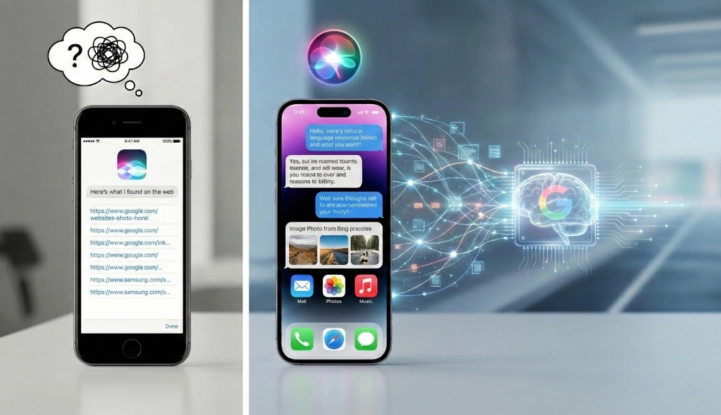
This integration is designed to automate a professional-grade workflow for the average user. Rather than providing simple scripted responses, the new Siri will utilize Gemini’s deep semantic understanding to parse ambiguous intent and execute tasks across multiple applications. For example, a user could ask Siri to “find that podcast recommendation from three weeks ago and schedule a time for me to listen to it when I’m not in meetings,” and the assistant would intuitively scan through Messages, Mail, and Calendar to deploy a solution.
| AI Model Layer | Parameter Count | Primary Function |
| On-Device Model | 3 Billion | Offline tasks, basic privacy-first queries |
| Current Cloud Model | 150 Billion | Standard summarization, email drafting |
| Custom Gemini Model | 1.2 Trillion | Complex planning, deep reasoning, multi-app workflows |
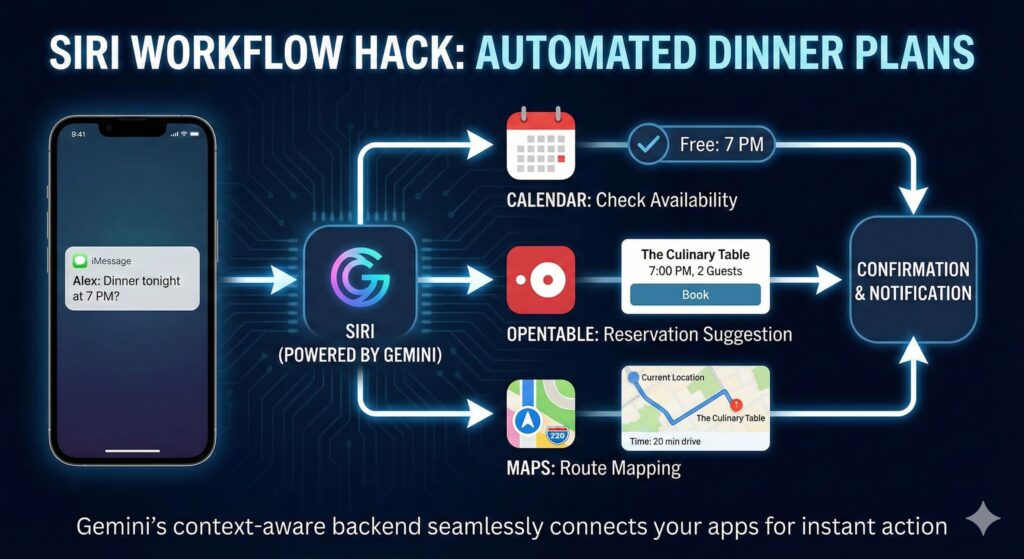
Privacy Architecture: The Private Cloud Compute Hack
For a brand built on the pillar of user security, integrating a rival’s AI model required a revolutionary approach to data governance. Apple has addressed this by deploying the Gemini models within its own “Private Cloud Compute” (PCC) infrastructure. This scalable architecture ensures that even when complex queries are sent to the cloud, the data remains walled off from Google’s primary infrastructure.
In this deployment, Apple runs the inference on its own silicon-powered servers, paying Google for the intellectual property and licensing of the Gemini weights rather than for cloud cycles on Google’s hardware. This non-negotiable architecture allows Apple to offer cutting-edge AI features without compromising its privacy-first philosophy. Legal teams are already drafting updated terms to ensure that these “sealed” data streams are transparently audited, maintaining the intuitive trust users have in the Apple ecosystem.
Market Disruption: Alphabet’s $4 Trillion Ascendance
The financial implications of this partnership have sent shockwaves through the tech sector, directly fueling Alphabet’s surge into the exclusive $4 trillion market capitalization club. Investors have modeled the deal as a massive revenue boost for Google, with estimated annual payments from Apple reaching approximately $1 billion. More importantly, the partnership validates Gemini’s scalability as a “bellwether” technology, proving that even its most prominent hardware rivals view it as the most capable foundation for the next generation of AI.
Conversely, this alliance has forced a “Code Red” scenario at OpenAI. While the existing ChatGPT integration for specialized world knowledge remains intact for now, the decision to use Gemini for Siri’s “brain” indicates that Apple views Google as the more stable and reliable long-term partner. This strategic pivot protects Google’s search relevance in a future where conversational assistants become the primary gateways to information and commerce.
The Roadmap: Deploying iOS 26.4 and Beyond
The timeline for this intuitive overhaul is already coming into focus. While Apple first demoed an AI-powered Siri at WWDC 2024, technical hurdles and organizational shifts delayed the initial launch. Current reports indicate that the Gemini-powered Siri will reach users at scale with the release of iOS 26.4, expected in the spring of 2026.
This rollout will be a phased deployment, starting with summarization and text synthesis tools before moving toward the more advanced “planner” capabilities showcased at previous developer conferences. By renting rather than rebuilding these extreme-scale models, Apple preserves its capital discipline while gaining immediate access to state-of-the-art competence.
| Milestone | Expected Date | Key Feature Deployment |
| Gemini Integration Confirmed | January 2026 | Strategic partnership and $1B/year deal announced |
| iOS 26.4 Public Beta | March 2026 | First look at Gemini-powered summarizer and email tools |
| WWDC 2026 | June 2026 | Preview of advanced multimodal and planner workflows |
| Full Ecosystem Integration | Fall 2026 | Seamless integration across iPhone 18 Pro, Mac, and iPad |
Conclusion: A Future-Proof Alliance
The Apple-Google partnership is more than a simple business deal; it is a pragmatic recognition that the future of mobile computing depends on the seamless integration of hardware, privacy, and extreme-scale intelligence. By optimizing its workflow through the deployment of Gemini, Apple is transforming Siri from a simple command-line interface into a proactive, intuitive agent that can manage the complexities of modern digital life.
For tech professionals and consumers alike, the message is clear: the voice assistant market is no longer about who has the best hardware, but who can deploy the most capable and trusted “artificial mind.” With a $5 billion valuation and the backing of two of the world’s most powerful companies, the Gemini-Siri alliance is set to disrupt the industry and redefine the standard for the next decade of AI interaction.