




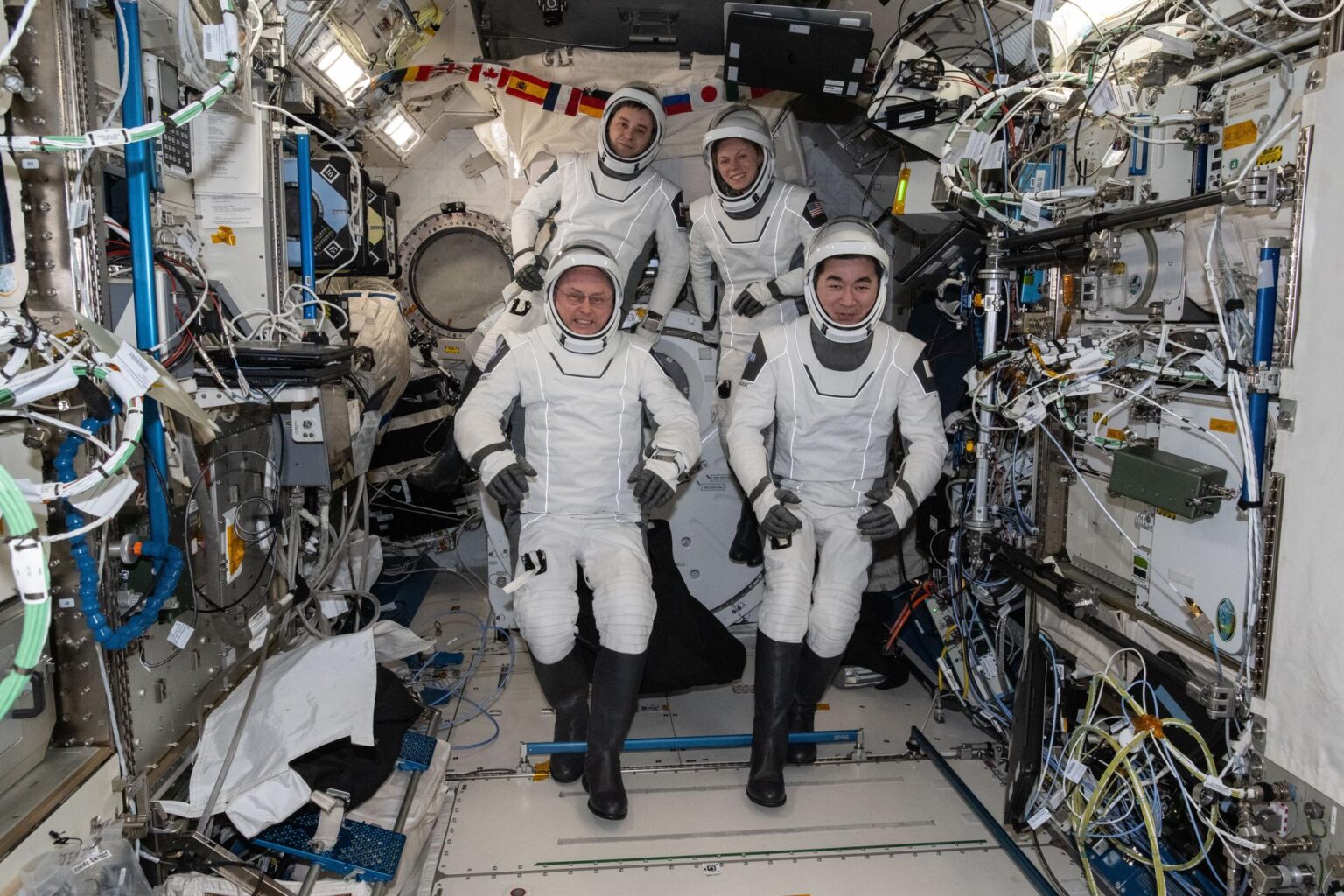
On January 15, 2026, the SpaceX Dragon spacecraft Endeavour streaked across the predawn sky over the Pacific Ocean, its heat shield glowing as it re-entered Earth’s atmosphere at 17,500 miles per hour. Aboard were NASA astronauts Zena Cardman and Mike Fincke, JAXA’s Kimiya Yui, and Roscosmos cosmonaut Oleg Platonov.
Their splashdown off the coast of San Diego marked the end of a 167-day journey. While the crew was originally slated to remain in orbit until February, NASA made the historic decision to bring them home nearly a month early due to an undisclosed medical situation involving one of the crew members.
Despite the abrupt end, the science “wrapped up” by Crew-11 represents a massive leap forward in our quest to reach Mars and our ability to heal patients here on Earth.
1. The Science of the “Medical Evacuation”
For the first time since the ISS became permanently inhabited in 2000, NASA initiated a medical return. While the agency has maintained strict privacy regarding which astronaut was affected, the decision underscores a fundamental truth about space exploration: Space is a harsh biological frontier.
The Logistics of an Orbital Rescue:
- The Decision: On January 7, a planned spacewalk (EVA 94) was abruptly canceled. By January 8, NASA Administrator Jared Isaacman announced the early return.
- Stable but Strategic: NASA emphasized that the astronaut was stable, but the mission was cut short because the “diagnostic and treatment capabilities” required for this specific condition do not yet exist on the ISS.
- Historical Precedent: While the Soviet Union had a similar early return from the Salyut 7 station in 1985, this was a first for the ISS, proving that the SpaceX Dragon system can serve as a highly effective “orbital ambulance” when seconds and safety count.
2. Biological Breakthroughs: Regenerative Medicine in Microgravity
One of the primary goals of Crew-11 was to utilize the weightless environment of the ISS to grow biological tissues that are impossible to cultivate on Earth. On Earth, gravity causes cells to settle and grow in flat 2D layers. In space, they grow in 3D, mimicking how they actually function inside the human body.
Vascular Tissue and Organ Printing
Stemming from NASA’s Vascular Tissue Challenge, the crew worked on bio-printing complex liver and heart tissues. By 2026, the goal has shifted from “observation” to “manufacturing.” The data brought back by Crew-11 could pave the way for future organ replacements, allowing scientists to grow healthy tissue using a patient’s own stem cells in orbit and then returning them to Earth for transplant.
Stem Cell Proliferation
The crew collaborated with Cedars-Sinai Medical Center to evaluate if induced pluripotent stem cells divide faster in microgravity. Preliminary data suggests that the “stress” of spaceflight might actually accelerate certain regenerative processes, offering a potential “fast-track” for treating neurodegenerative conditions like Alzheimer’s or heart disease.
3. The CIPHER Study: Preparing for Mars
Crew-11 were key participants in CIPHER (Complement of Integrated Protocols for Human Exploration Research). This is a massive, multi-year study looking at how the human body changes over long-duration spaceflight.
Key Focus Areas for Crew-11:
- Bone Density: Zena Cardman conducted extensive work with bone stem cells to understand the mechanism of bone loss. This research helps protect astronauts on the way to Mars and informs treatments for osteoporosis patients on Earth.
- Core Temperature Regulation: Astronaut Mike Fincke tested a new non-invasive, headband-style sensor that tracks how the body regulates its temperature in space. Interestingly, this technology is already being adapted for Earth-based workers in high-heat environments, like firefighters and steel mill workers.
- Vision and Brain Health: The crew underwent frequent scans to monitor “Spaceflight-Associated Neuro-Ocular Syndrome” (SANS), where the shift in bodily fluids toward the head puts pressure on the optic nerve.
4. Technology Demonstrations: Cleaning Up Low Earth Orbit
Space is getting crowded. With the rise of “mega-constellations” like Starlink and Kuiper, the risk of space debris is at an all-time high. Crew-11 tested a revolutionary “Space Catch” system.
The Inflatable Capture Bag:
Mike Fincke performed tests on a prototype inflatable capture bag designed by TransAstra Corporation. This system is intended to “swallow” defunct satellites or debris fragments, preventing them from colliding with the ISS or other active spacecraft. By validating that the bag can open, close, and maintain its seal in microgravity, Crew-11 has provided the blueprints for the first “orbital garbage trucks.”
5. Nutrition and Life Support: Space Yogurt and Fresh Food
As we look toward 1,000-day missions to Mars, we cannot rely on pre-packaged “pouch food.” Nutrients like Vitamin C and Thiamine degrade over time in storage.
The “Nutrients on Demand” Project:
JAXA’s Kimiya Yui was frequently seen on the NASA livestream working with the HTV-X1 cargo vehicle’s new science payloads. One of the most popular experiments was the production of “Space Yogurt.” Using specifically engineered microorganisms, the crew was able to produce fresh, nutrient-dense yogurt on demand. This isn’t just a culinary luxury; it is a proof-of-concept for biological “factories” that will keep future Martians healthy.
6. Earth Observation: 25 Years of Perspective
While high-resolution satellites provide a lot of data, there is no substitute for the human eye and a hand-held camera. Crew-11 continued the tradition of documenting our changing planet from 250 miles up.
The crew captured over 10,000 images of Earth, documenting:
- The dramatic retreat of glacial ice in the Andes.
- Urban growth patterns in the “megacities” of Southeast Asia.
- The impact of the 2025-26 solar cycle on Earth’s atmosphere (the Aurora Borealis was particularly vivid during their mission).
7. What Happens Next? The ISS “Skeleton Crew”
The early departure of Crew-11 has left the International Space Station in a rare “skeleton crew” configuration. Currently, only three humans remain aboard the station:
- Chris Williams (NASA)
- Sergey Kud-Sverchkov (Roscosmos)
- Sergei Mikaev (Roscosmos)
Because a two-person team is required for any spacewalk, and a third is required to monitor from inside, all planned spacewalks are currently suspended. The station is in “maintenance-only” mode until the launch of SpaceX Crew-12, which NASA has now fast-tracked to February 15, 2026.
8. Conclusion: A Mission Defined by Resilience
NASA’s SpaceX Crew-11 mission will be studied by space historians for decades. It proved that international cooperation remains strong—with American, Japanese, and Russian crew members working as a single unit during a medical crisis.
Commander Zena Cardman summed it up best shortly before undocking: “Our timing of this departure is unexpected, but what was not surprising to me was how well this crew came together as a family.”
The 850+ hours of research they “wrapped up” are now being analyzed by scientists in Houston, Tokyo, and Moscow. From the bone cells that may cure osteoporosis to the capture bags that will keep our orbits safe, the legacy of Crew-11 is one of triumph over adversity.
Crew-11 Science Summary Table
| Investigation | Primary Goal | Earth Benefit |
| Vascular Tissue | 3D printing human organs | Organ transplant solutions |
| CIPHER | Monitoring body adaptation | Aging and bone health research |
| Space Catch | Debris removal technology | Safer satellite infrastructure |
| Nutrients on Demand | Fresh food production (Yogurt) | Nutrition for remote Earth regions |
| Device Edge | Edge computing in orbit | Better real-time data processing |
| Vascular Aging | Studying heart health in space | Heart disease prevention |