




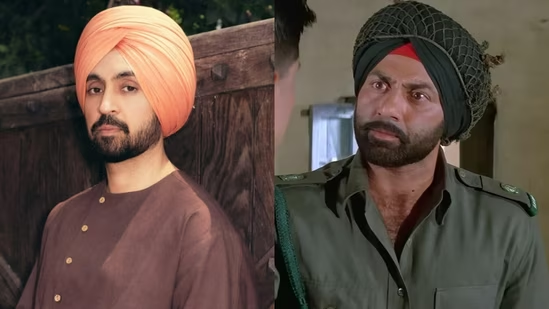
For many Indians, the 1997 war drama Border starring Sunny Deol remains a cinematic milestone — a story of bravery that captured hearts across the country. Yet for a young Diljit Dosanjh, then a boy with big dreams, watching this legendary film in a theatre was something he couldn’t afford. Decades later, Dosanjh isn’t just recalling those memories — he stars in the sequel, Border 2, playing a celebrated Indian Air Force hero himself.
The contrast between his modest childhood experience and his current success offers a powerful story of aspiration, gratitude, and how far hard work can take someone when passion meets opportunity.
The Buzz Around Border — and a Childhood Memory
Released in 1997 and directed by J.P. Dutta, Border became one of Bollywood’s most memorable patriotic films, celebrated for its emotional depth, powerful performances, and sweeping depictions of wartime sacrifice. The movie was a nationwide conversation starter, and everyone seemed to be talking about it.
However, a young Diljit Dosanjh wasn’t one of those who experienced it in the packed theatres. In a candid video he shared on Instagram, he recounted how:
- His family couldn’t afford to buy cinema tickets at the time.
- Even if they wanted to go, his parents were hesitant about theatre visits.
- So he waited patiently to watch the film when it aired on television.
“I remember when the first Border came, so many people around me went to watch it, but I couldn’t because I didn’t have the money. My family didn’t even allow theatre visits then, and we simply couldn’t afford the tickets,” Diljit shared, describing how he’d eagerly await its TV premiere instead.
He also added that when someone from his neighbourhood watched the film in a theatre and came back excited, it made him even more eager to see it on the small screen.
Watching Border on TV: A Boy’s First Connection to Cinema Culture
Although cinema halls were out of reach, television became the medium through which Dosanjh watched Border — not just once, but two to three times, he said.
For the young boy, the film wasn’t just entertainment — it was an experience that connected him emotionally to the idea of cinema and storytelling. He recalled how people talked about the atmosphere inside those theatres, the applause, and the overall excitement — all of which made him look forward eagerly to his turn to watch the film on TV.
That excitement wasn’t just about the film itself; it was part of growing up and dreaming about what cinema could one day mean to him.
A Full‑Circle Moment: Starring in Border 2
Fast forward nearly three decades, and Diljit Dosanjh now finds himself not only part of the film industry but a central figure in Border 2 — the sequel to the original blockbuster.
In Border 2, Dosanjh plays Param Vir Chakra Flying Officer Nirmal Jit Singh Sekhon, a real‑life Indian Air Force hero known for his valor. The role is both significant in terms of screen presence and deeply symbolic, considering his childhood connection to the Border franchise.
Sharing this almost surreal transition from watching Border on a small TV screen to acting in its sequel, Diljit said he feels grateful and more blessed than deserving, expressing that whatever he has achieved is something he accepts with gratitude.
Personal Reflections: Gratitude and Humility
Despite his success, Dosanjh’s message was full of humility. He specifically said:
“Whatever God is giving me, I am taking it. I don’t consider myself worthy enough to be part of this film, but I’m grateful for whatever God has given me.”
These words resonate not just with fans but with anyone who comes from modest beginnings and makes it big in their chosen field. His reflection goes beyond celebrity anecdote — it speaks to perseverance, dreams, and appreciation for life’s opportunities.
The Success of Border 2
Dosanjh’s journey from watching Border on TV to starring in Border 2 coincides with strong performance at the box office. The sequel — directed by Anurag Singh and featuring stars like Sunny Deol, Varun Dhawan, and Ahan Shetty — has opened to impressive collections, earning ₹30 crore on its first day and continuing solid momentum.
The film’s success reflects both nostalgia for the original and audience interest in this new generation of storytelling, blending familiar faces with fresh talent like Dosanjh’s.
Why This Story Resonates
Diljit Dosanjh’s recollection strikes a chord for several reasons:
1. Relatability
Many people from middle‑class or economically challenged backgrounds have similar memories — waiting to see a beloved film on TV because theatres were too expensive. Diljit’s personal story gives voice to that shared cultural experience.
2. Humble Beginnings
The fact that he couldn’t afford a ticket in his youth and now plays a lead role in a major Bollywood film franchise shows a dramatic and inspiring arc of persistence and hard work.
3. Emotional Connection
His reflections weren’t just nostalgic — they were heartfelt. He talked about feeling blessed and genuinely grateful, rather than boastful about his success.
4. Full‑Circle Inspiration
This narrative becomes a motivational tale for aspiring artists and young dreamers: what once seemed out of reach may one day be part of your own journey.
The Cultural Impact of Border
To understand why this story matters, it helps to remember the impact of the original Border film in 1997. Directed by J.P. Dutta, it became one of the defining war films in Bollywood, celebrated for its portrayal of bravery and sacrifice during the 1971 India‑Pakistan war. It starred Sunny Deol, Suniel Shetty, Akshaye Khanna, and Jackie Shroff — all delivering performances that became deeply memorable in Indian cinema history.
The film resonated not only for its narrative but also for the enthusiastic audience response. People talked about the buzz and environment inside theatres, making Border more than just a movie — it was a cultural moment.
For someone like Diljit — whose early experiences with cinema were shaped by financial limits — being part of the same cinematic world is highly meaningful.
Reflection on Cinema, Dreams, and Change
Cinema often serves as both a mirror and a window — reflecting society while also offering glimpses into dreams beyond one’s immediate reality. Diljit’s story exemplifies that dual nature:
- Mirror: His financial limitations as a child mirror a reality many Indians share.
- Window: His rise to starring in a major war drama offers a window of hope that persistence and talent can break barriers.
His evolution from watching Border from a distance to living the cinematic dream reminds us that films influence not only entertainment but the aspirations of individuals and communities.
Conclusion: A Story of Life Imitating Art
Diljit Dosanjh’s recollection of not having enough money to watch Border in theatres — and then becoming a key part of Border 2 — is a powerful full‑circle moment that goes beyond celebrity gossip. It’s a personal testimony to the unpredictable magic of life, where childhood dreams can transform into professional milestones.
This is not just a story of box office numbers or film promotion; it’s a narrative about humility, gratitude, and the beauty of achieving success without losing touch with one’s roots.
As audiences enjoy Border 2 on the big screen, many are watching not just a film — but the evolution of a dream once thought unreachable by a young boy who lacked the money for a movie ticket, and now stands tall among its stars.