




The depths of the ocean have always been one of Earth’s greatest mysteries. Hidden beneath crushing pressure, complete darkness, and extreme cold lies a world that continues to surprise scientists. In a recent deep-sea expedition, researchers made a startling discovery nearly 6,200 meters below the surface of the Pacific Ocean—strange black “eggs” that revealed something entirely unexpected when opened.
This discovery has not only fascinated the scientific community but also raised new questions about life in extreme environments and the limits of biological adaptation.
The Discovery in the Abyss
Exploring depths of over 6,000 meters is no easy feat. At such extreme depths:
- Sunlight cannot penetrate
- Temperatures are near freezing
- Pressure is over 600 times that at sea level
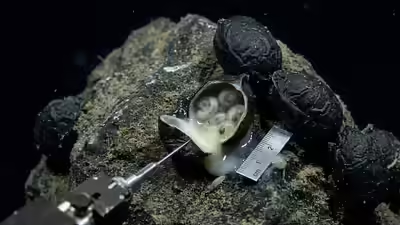
Yet, it is in this hostile environment that scientists came across unusual black, egg-like structures scattered across the ocean floor.
At first glance, these objects appeared organic—but their exact nature was unclear. Were they eggs? Mineral formations? Or something entirely new?
What Made These “Eggs” So Unusual?
The black structures stood out for several reasons:
1. Uniform Appearance
They appeared similar in size and shape, suggesting a biological origin.
2. Dark Outer Layer
The black coating was unlike typical marine eggs, which are often translucent or lightly colored.
3. Location
They were found in one of the most extreme and least explored regions of the Pacific Ocean.
These factors made the discovery intriguing enough for scientists to collect samples for closer examination.
The Shocking Discovery Inside
When researchers carefully opened the structures, what they found was both surprising and fascinating.
Inside were:
- Gel-like substances
- Possible embryonic forms
- Organic material suggesting life
While initial findings point toward these being egg cases of a deep-sea organism, the exact species is still under investigation.
This revelation suggests that even at extreme depths, life not only exists but reproduces in ways we are just beginning to understand.
Life in Extreme Conditions
The discovery reinforces a growing understanding in science: life is incredibly adaptable.
Organisms living at such depths must survive:
- Crushing pressure
- Lack of sunlight
- Limited food sources
To do so, they develop unique adaptations such as:
- Slow metabolism
- Bioluminescence
- Specialized reproductive strategies
The black “eggs” could represent a previously unknown adaptation to these harsh conditions.
Why This Discovery Matters
This finding is significant for several reasons:
1. Expanding Knowledge of Marine Life
It adds to our understanding of biodiversity in the deep sea.
2. Insights into Evolution
Studying such organisms can reveal how life evolves under extreme conditions.
3. Potential Scientific Applications
Deep-sea organisms often possess unique biochemical properties that could have applications in medicine and technology.
The Mystery of the Species
One of the biggest questions remains: What organism do these eggs belong to?
Scientists are currently analyzing:
- DNA samples
- Chemical composition
- Structural features
Possible candidates include:
- Deep-sea fish
- Unknown invertebrates
- Previously undiscovered species
Until further research is completed, the mystery remains unsolved.
Challenges of Deep-Sea Exploration
Discoveries like this highlight both the potential and the difficulty of exploring the deep ocean.
Key Challenges:
- High cost of equipment
- Limited access to extreme depths
- Technical difficulties in sample collection
Despite these obstacles, advancements in technology are making it increasingly possible to explore these hidden worlds.
The Role of Technology
Modern deep-sea exploration relies on advanced tools such as:
- Remotely operated vehicles (ROVs)
- Deep-sea submersibles
- High-resolution imaging systems
These technologies allow scientists to:
- Capture detailed visuals
- Collect samples safely
- Study environments in real time
Without them, discoveries like the black “eggs” would not be possible.
Could This Change What We Know About Life?
Findings like this challenge our assumptions about where and how life can exist.
They raise important questions:
- Could similar life forms exist on other planets?
- How resilient is life under extreme conditions?
- Are there entire ecosystems yet to be discovered?
The deep sea is often compared to outer space in terms of mystery—and discoveries like this bring us one step closer to understanding both.
Public Fascination with the Unknown
The idea of mysterious “eggs” deep in the ocean has captured public imagination.
It combines:
- Science
- Mystery
- Exploration
Such discoveries remind us how much of our own planet remains unexplored.
What Comes Next?
Scientists will continue to study the samples to:
- Identify the species
- Understand the reproductive process
- Determine ecological significance
Further expeditions may also:
- Locate more such structures
- Observe them in their natural state
- Gather additional data
Conclusion
The discovery of black “eggs” 6,200 meters beneath the Pacific Ocean is a powerful reminder of how little we know about the deep sea.
What initially appeared to be strange objects has turned into a fascinating scientific mystery—one that could reshape our understanding of life in extreme environments.
As research continues, one thing is clear: the ocean still holds countless secrets waiting to be uncovered.
And with every discovery, we are reminded that the greatest mysteries on Earth may lie not above us in the stars—but deep below, in the silent darkness of the sea.