




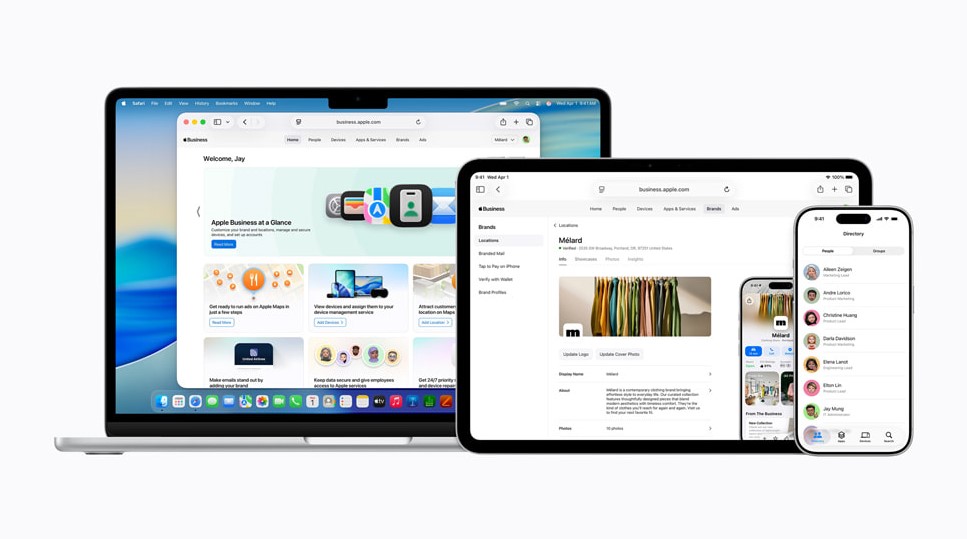
Apple has officially announced a brand-new platform called Apple Business, set to launch globally on April 14, 2026. The service will roll out in over 200 countries and regions, marking one of Apple’s most ambitious expansions in the enterprise and small business space.
Designed as an all-in-one business solution, the platform brings together Apple’s existing tools into a single unified ecosystem.
Global Launch Details
- Launch date: April 14, 2026
- Availability: 200+ countries and regions
- Target users: Small businesses, startups, and enterprises
Apple confirmed that the platform will be available globally from day one, making it accessible to businesses worldwide without staggered rollouts.
What Is Apple Business?
Apple Business is a unified platform that combines multiple business tools into one system.
Core Capabilities:
- Built-in mobile device management (MDM)
- Business email, calendar, and directory services
- Support for custom domain names
- Centralized control over employees, devices, and apps
The goal is to simplify how companies manage operations, collaborate, and scale their digital presence.
Replacing Older Apple Services
With the launch of Apple Business, Apple is consolidating several existing services:
- Apple Business Essentials
- Apple Business Manager
- Apple Business Connect
All of these will be phased out and replaced by the new unified platform.
Existing user data will be automatically migrated, ensuring a smooth transition.
Key Features & Tools
1. Device Management Made Easy
Businesses can:
- Configure employee devices remotely
- Apply security settings and policies
- Deploy apps automatically
This is especially useful for companies without dedicated IT teams.
2. Built-in Communication Tools
Apple Business includes:
- Professional email with custom domains
- Shared calendars
- Employee directories
This creates a seamless communication environment within organizations.
3. Customer Reach & Growth
One of the standout features is integration with Apple’s ecosystem:
- Apple Maps
- Apple Wallet
- Siri
Businesses can improve visibility and connect with customers directly through these platforms.
4. Advertising & Discovery (Upcoming)
Apple is also planning new features such as:
- Local ads in Apple Maps (starting in select regions)
- Insights into customer interactions and search behavior
This signals Apple’s growing focus on services and advertising revenue.
Pricing & Availability
- The platform will be free to use for basic features
- Additional services like:
- Extra iCloud storage
- AppleCare+ for Business
will be paid add-ons
This freemium model makes it attractive for small businesses while still offering scalability.
Why This Matters
The launch of Apple Business is significant because:
- It simplifies Apple’s fragmented business ecosystem
- Expands Apple’s presence in enterprise services
- Competes with platforms like Google Workspace and Microsoft 365
- Strengthens Apple’s push into services revenue
It also lowers the barrier for small businesses to adopt Apple’s ecosystem.
Impact on Businesses
For businesses, especially in markets like India:
Benefits:
- Easier device and employee management
- Professional communication tools in one place
- Better customer engagement via Apple apps
- Reduced need for third-party tools
This could be particularly useful for startups and SMEs looking for a simple, secure ecosystem.
Conclusion
With its April 14 global rollout, Apple Business represents a major step in Apple’s strategy to unify and expand its business services.
By combining device management, communication tools, and customer engagement features into one platform, Apple is positioning itself as a serious player in the business software space.
If widely adopted, Apple Business could redefine how companies use Apple’s ecosystem—not just for devices, but for running entire operations. 💼📱