





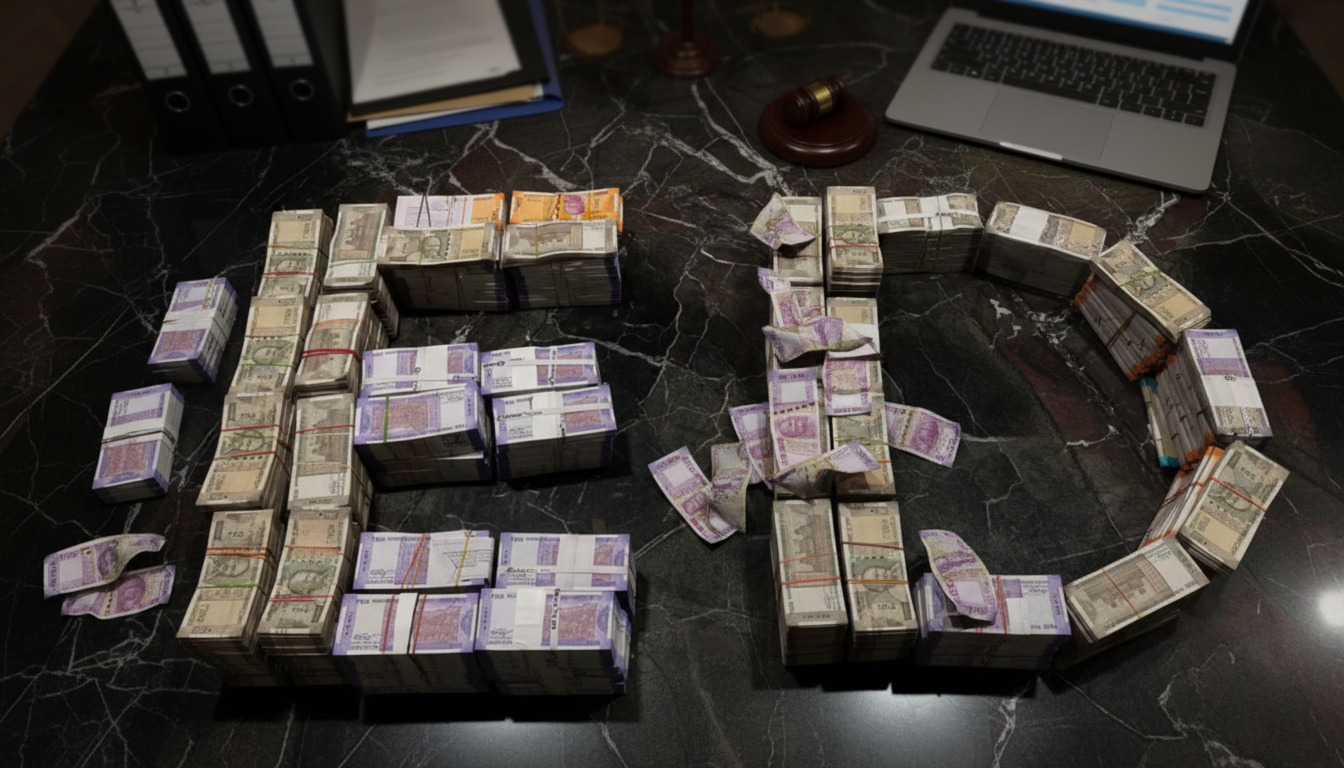
The dream of owning a home is often the biggest financial commitment an Indian family makes. For over 1,000 allottees of the “Expressway Towers” project in Sector 109, Gurugram, that dream turned into a legal nightmare. The ED’s recent chargesheet against Swaraj Singh Yadav exposes how a government-subsidized scheme was allegedly weaponized for personal enrichment.
1. The Core of the Fraud: A “Dual Payment” Modus Operandi
The ED investigation reveals a calculated strategy designed to squeeze maximum profit out of single residential units.
- Fabricated Cancellations: The agency alleges that OSBPL systematically cancelled the allotments of genuine PMAY applicants under “false pretexts,” such as non-payment of dues, even when payments were up to date.
- The Resale Markup: Units originally priced at ₹26.5 lakh (under PMAY norms) were allegedly resold to new buyers for ₹40–50 lakh.
- No Refunds: Crucially, the ED found that the original buyers were never refunded their deposits. The builder allegedly pocketed the “dual proceeds”—the original deposit plus the inflated price from the second buyer.
- Cash Premiums: A substantial portion of these resales was allegedly conducted in cash, over and above the legally permissible price, to evade the banking trail.
2. Systematic Diversion of Funds
Instead of using the collected funds to complete the construction of “Expressway Towers”—which remains stalled at roughly 65–70% completion despite a 2022 deadline—the money was reportedly siphoned off.
- Shell Company Web: Funds were routed through a network of dummy entities, including KTP Infratech Pvt. Ltd., to layer the transactions.
- Luxury Assets: The “Proceeds of Crime” were allegedly used to acquire a villa, a hotel, a resort, and several land parcels across Gurugram, Himachal Pradesh, and Maharashtra.
- Foreign Transfers: The ED detected “huge” transfers to the United States via hawala channels. These funds were reportedly used to support Yadav’s family; the agency noted that his wife, Sunita Swaraj, relocated to Boston in August 2025.
3. Assets Attached: Recovering the Proceeds of Crime
Just days before filing the chargesheet, on January 5, 2026, the ED issued a Provisional Attachment Order for assets valued at ₹51.57 crore.
The Attached Portfolio Includes:
- A luxury villa and multiple office spaces in Gurugram.
- A resort property in Himachal Pradesh.
- Land parcels in Maharashtra.
- Multiple bank balances tied to the promoter and his associated firms.
The agency is currently conducting a valuation exercise for further assets to ensure they can eventually be restituted to the victimized homebuyers.
4. Legal Status: Flight Risk and Judicial Custody
Swaraj Singh Yadav was arrested on November 13, 2025, after the ED flagged a “pattern of accelerated liquidation.” Fearing he would sell off his remaining domestic assets and flee the country to join his family in the US, the agency moved for his arrest.
During the remand proceedings, Yadav’s legal team argued that many of the original FIRs (filed by Delhi and Haryana Police) had been “settled.” However, the Special PMLA court rejected this, noting that the money laundering aspect constitutes an independent and serious offense against the state and public at large.
5. Comparative Context: PMAY vs. Traditional Real Estate Fraud
| Feature | Standard Realty Fraud | The OSBPL/PMAY Fraud (2026) |
| Target Audience | Luxury/HNI Buyers | Middle-income / First-time buyers |
| Government Link | Private project | Subsidized under PMAY |
| Primary Offense | Construction delay | Illegal cancellation & inflated resale |
| Fund Diversion | To other projects | To personal luxury assets & Hawala |
| ED Focus | ₹50–100 Cr average | ₹222 Crore targeted |
6. Impact on the Affordable Housing Sector
This case has sent shockwaves through the National Capital Region (NCR) real estate market. It highlights a critical vulnerability in the PMAY framework: the ease with which a builder can cancel a subsidized allotment and flip it for a market-rate profit.
Industry experts are now calling for:
- Stricter Escrow Audits: Real-time monitoring of PMAY project funds to prevent diversion to personal accounts.
- RERA Oversight on Cancellations: Requiring builders to get RERA approval before cancelling any PMAY allotment.
- Digital Transparency: A public portal where PMAY allottees can check the real-time status of their unit’s ownership.
Conclusion: Justice for the 1,089 Allottees?
With the filing of the chargesheet, the legal battle moves into the trial phase. For the 1,089 families left stranded in unfinished apartments in Sector 109, the ED’s aggressive asset attachment offers a glimmer of hope. However, as the investigation continues to identify more “Proceeds of Crime,” the focus remains on whether these homes can ever be finished and delivered to their rightful owners.
The OSBPL case serves as a grim reminder that even government-backed schemes require eternal vigilance against the “calculated abuse of trust.”
Executive Summary Checklist
- The Accused: Swaraj Singh Yadav (Promoter, Ocean Seven Buildtech).
- The Charge: Money laundering and fraud involving ₹222 crore.
- The Scheme: Misusing the Pradhan Mantri Awas Yojana (PMAY) for illegal cancellations and resales.
- Asset Status: ₹51.57 crore worth of luxury properties provisionally attached in Jan 2026.
- The Status: Yadav is in judicial custody; trial to begin in the Special PMLA Court.