




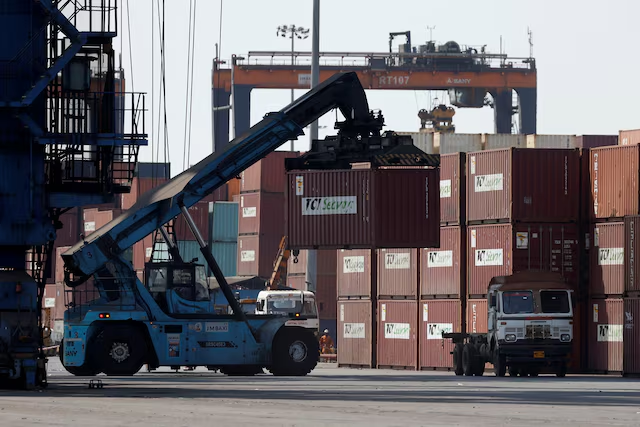
India’s government is preparing a major economic strategy to triple annual exports by 2035, reflecting a renewed push to strengthen the country’s role in global trade and manufacturing. Officials say the target involves raising annual goods exports from current levels toward approximately $1.3 trillion (about ₹108 lakh crore) by the mid-2030s.
This export goal builds on strong recent performance — with total merchandise and services exports on track to cross the $1 trillion mark around 2025–26 — but aims to sustain long-term growth far beyond current achievements.
Focus on Manufacturing and Structural Reform
The export strategy is tightly linked to a manufacturing push that prioritises 15 key sectors ranging from high-tech industries like semiconductors and energy storage to labour-intensive ones such as leather and metals.
Rather than relying on large fiscal handouts, Delhi is emphasising structural and regulatory reforms to improve the business environment. Key elements include:
- Reducing red tape and compliance burdens that slow factory set-ups and expansion.
- Easing permitting and clearances for land, power, and infrastructure access.
- Building manufacturing hubs and clusters near strategic infrastructure like ports.
- Harmonising state-level labour and business regulations to attract investment and boost productivity.
Officials say this approach marks the third major attempt under the current government to elevate manufacturing’s share of GDP and underpin export growth after earlier “Make in India” campaigns and incentive packages showed only incremental progress.
Export Promotion Mission and Policy Support
In addition to structural reform, the India government has launched policy initiatives designed to strengthen the export ecosystem:
🔹 Export Promotion Mission
The Union Cabinet approved a flagship Export Promotion Mission with an outlay of ₹25,060 crore (US-dollar equivalent) for FY 2025–26 to FY 2030–31.
This mission consolidates multiple fragmented schemes into a digitally driven, outcome-oriented framework to support exporters — especially micro, small and medium enterprises (MSMEs), first-time exporters, and labour-intensive sectors — tackle trade finance, compliance, logistics, and marketing challenges.
Sector Targets and Growth Drivers
India is carving out specific targets within its larger export goal:
- Electronics and textiles are being pushed toward ambitious export targets by FY 2030, reflecting India’s strengths in IT hardware and garment production.
- Services exports, particularly in IT and business services, are expected to play a significant role in overall export expansion through the decade.
Why This Matters
Economic transformation: Tripling exports could significantly enhance India’s GDP growth, create millions of jobs, and strengthen foreign exchange reserves.
Diversification: Focusing on both high-tech and tradable labour-intensive sectors helps diversify the export mix and reduce over-dependence on a few industries.
Competitiveness: Streamlined regulations and targeted incentives aim to boost competitiveness, making Indian products and services more attractive in global markets.
MSME empowerment: With nearly half of India’s exports already coming from MSMEs and their global integration deepening, export growth could expand opportunities for smaller enterprises.
Outlook and Challenges
While the target is ambitious, analysts note that India’s recent momentum — including expected export levels around $1 trillion — provides a strong foundation. However, achieving a near-threefold increase by 2035 will require sustained reform, investment in infrastructure and skills, deeper integration into global value chains, and continued diversification of trading partners.
In Summary
- India plans to triple exports by 2035, targeting about $1.3 trillion in annual goods shipments through manufacturing, regulatory reform, and export promotion.
- The strategy emphasises structural changes rather than large subsidies to invigorate manufacturing and simplify the business environment.
- A new Export Promotion Mission seeks to unify export support and help MSMEs and first-time exporters compete internationally.
This export ambition is a central pillar of India’s economic strategy for the next decade — positioned to boost growth, jobs, and global trade presence as the nation moves toward 2035.