


In 2026, the question isn’t if we can send life to Mars, but how we can keep it from dying the moment it arrives. Mars is a world of extremes: average temperatures of -62°C, an atmosphere that is 96% Carbon Dioxide, and a radiation environment that can shred DNA in weeks.1
To “export” life successfully, we must follow a tiered strategy that mirrors the evolution of life on Earth, but at a vastly accelerated pace.
Phase 1: The Micro-Colonizers (2026–2030)
Before humans can step onto the Martian regolith, we must export the “foundation” of life: Extremophiles.
The Role of Cyanobacteria
Research published earlier this month (January 2026) highlights that certain strains of Earth’s earliest life forms, like Chroococcidiopsis, are the perfect candidates for Mars.
- The Mission: These bacteria can survive in high-UV, low-moisture environments. Their job is to perform “Biological In-Situ Resource Utilization” (BISRU).
- The Goal: They will live in sealed translucent tubes on the surface, converting Martian $CO_2$ and sunlight into oxygen and biomass. This biomass will eventually become the “proto-soil” required for higher plants.
Moss: The Pioneer Plant
A breakthrough experiment aboard the ISS in 2025 showed that spreading earthmoss (Physcomitrium patens) spores can survive open space vacuum and radiation for nearly 300 days. Moss is the ideal export because it doesn’t need deep soil—it can cling to rocks and slowly break them down into minerals, creating a habitable surface for more complex life.
Phase 2: The Hardware (Transporting the Cargo)
Exporting life requires a “truck” capable of moving millions of tons of biological support equipment. As of today, the SpaceX Starship is the only vehicle designed for this scale.
The 2026 Window
SpaceX is currently preparing for the 2026 Mars Launch Window.2 This uncrewed mission aims to land the first Starships in the Arcadia Planitia region.3
- Why Arcadia? It has massive deposits of shallow water ice.4 You cannot export life without a local water source; the cost of transporting “wet” water from Earth is $100 million per metric ton.
- Optimus Robots: The first “lives” to step onto Mars in 2027 (when these ships arrive) will actually be Tesla Optimus robots.5 They will serve as the labor force, setting up the greenhouses and power plants that biological life will require.
Phase 3: Terraforming vs. Paraterraforming
How do we let life “out of the box”? There are two schools of thought in 2026:
A. Global Terraforming (The 1,000-Year Plan)
A recent 2024 study proposed using conductive nanorods made of Martian iron and aluminum.6
- The Process: We would release 30 liters of these rods per second into the atmosphere.7
- The Result: They would trap heat, raising the planetary temperature by 30°C within months. This would melt the polar ice, thickening the atmosphere and allowing liquid water to flow. Only then could we “export” an entire ecosystem.
B. Paraterraforming (The 10-Year Plan)
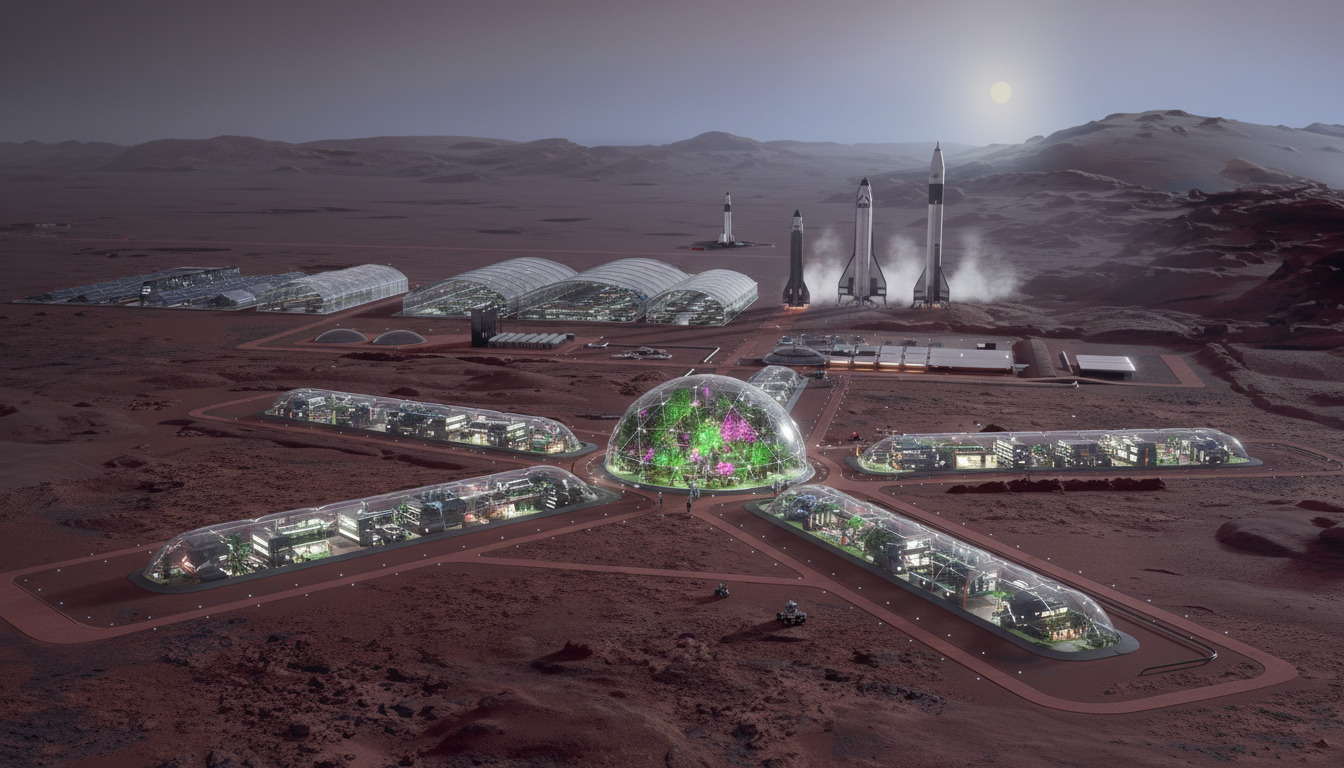
Since global terraforming takes centuries, 2026 scientists are focusing on Paraterraforming—building massive, pressurized “domes” or “lava tube cities.”
- The “Cave” Strategy: By exporting life into underground lava tubes, we use the Martian crust as a natural shield against cosmic radiation. This allows us to create Earth-like parks and farms beneath the surface almost immediately.
Phase 4: The Human Export (2029 and Beyond)
Sending humans is the most difficult “biological export” because our bodies are tuned to Earth’s specific parameters.
| Challenge | Impact on Human Life | 2026 Solution |
| Radiation | 700x Earth levels; high cancer risk. | Hydrogen-rich shielding & underground habitats. |
| Low Gravity | Bone density loss & vision issues. | Centripetal gravity on transit & rigorous exercise. |
| Isolation | Psychological breakdown / “Earth-sickness.” | High-speed Laser Comms & VR “Earth” environments. |
| Toxic Soil | Perchlorates in soil are toxic to life. | Hydroponics and “bioremediation” using specialized fungi. |
Phase 5: Ethical and Planetary Protection
Exporting life to Mars brings up a massive ethical dilemma: What if there is already life there?
In 2026, the Artemis Accords and COSPAR guidelines are being strictly enforced. We must ensure that our exported Earth bacteria don’t “eat” or outcompete native Martian microbes (if they exist). This is why the first “Life Export” ships are landing in desolate, ice-rich regions rather than the “Special Regions” like Jezero Crater where life is most likely to be found.
6. The Export Checklist: What’s on the Manifest?
If you were to look at the cargo manifest of a 2026 Marsbound Starship, you would see:
- Kilopower Reactors: Small nuclear fission units to provide 24/7 power during dust storms.
- Frozen Spore Banks: Millions of seeds and spores stored in lead-lined canisters.
- Lab-Grown Meat Bioreactors: We won’t export cows; we will export the cells to grow beef and chicken in vats.
- 3D Printers: Designed to use Martian dust to build “life shells” (habitats).
- Humanoid Robots: To do the dangerous work of “unpacking” the life-support systems.
Conclusion: Becoming Multiplanetary
Exporting life to Mars is the ultimate “insurance policy” for Earth’s biosphere. As Elon Musk stated in his May 2025 update, “If we have two planets, we keep going.” By the end of this decade, the first “Greenhouse of Mars” will likely be operational, lit by LED suns and protected by meters of Martian soil. It won’t look like the lush forests of Earth, but it will be a start—a small, green heartbeat on a cold, red world.
Executive Summary Checklist
- The Launchpad: 2026 is the target for the first Starship cargo fleets.8
- The Destination: Arcadia Planitia (for its water ice).
- The First Residents: Moss, Cyanobacteria, and Optimus Robots.
- The Power Source: Nuclear Fission (Solar is too unreliable due to dust).9
- The End Goal: A self-sustaining city of 1 million people by 2050.10