




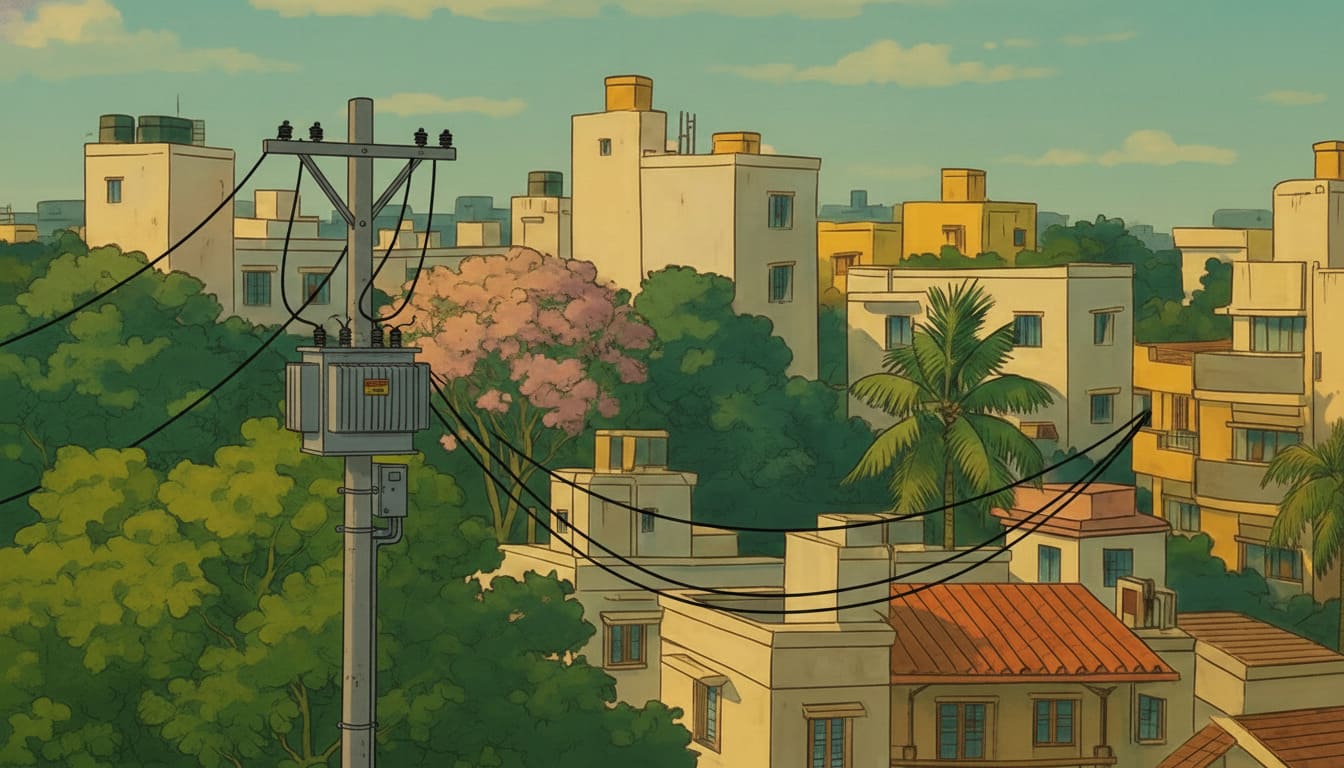
In a recent viral debate sparked by a homebuyer in India, experts and engineers have weighed in on a common urban dilemma: a house that ticks every box but sits less than 10 feet from a distribution transformer. While the initial lower price tag is tempting, the long-term reality involves a mix of scientific data, psychological barriers, and hard-nosed financial calculations.
1. The Safety Debate: Perceived vs. Real Risks
The biggest fear for any resident living near a transformer is a “blast” or fire. In India, where many transformers are pole-mounted and exposed to the elements, this concern is not entirely unfounded.
- Transformer Blasts: While catastrophic failures are statistically rare, they can occur due to prolonged overloading or poor maintenance. Oil-filled transformers, commonly used in India, contain flammable cooling oil. A fire or explosion within 6–7 feet of a residential boundary can lead to rapid fire spread and property damage.
- Monsoon Vulnerability: In cities prone to waterlogging like Mumbai, Chennai, or Bengaluru, submerged transformer bases can lead to earthing failures or short circuits. This creates a severe electrocution hazard for residents moving in and out of their gates.
- The Expert View: Testing engineers note that if a transformer is operating well within its rated capacity and is regularly maintained by the resident association (RWA) or local electricity board, the risk is minimal. “The problem isn’t the technology,” says Lokesh, a testing engineer, “it’s the lack of maintenance after handover.”
2. Health Concerns: The EMF Factor
The “Invisible Villain” in this discussion is Electromagnetic Fields (EMF). This is where science and public perception often clash.
- Extremely Low Frequency (ELF) EMFs: Transformers and power lines emit low-frequency magnetic fields. The World Health Organization (WHO) has categorized these fields as “possibly carcinogenic,” primarily due to limited epidemiological studies suggesting a link to childhood leukemia. However, the WHO also maintains that there is no established evidence of long-term health consequences from typical residential exposure levels.
- Distance Matters: EMF strength drops off exponentially with distance. A few meters can make a massive difference in exposure levels.
- The “Hair Dryer” Comparison: Engineers often point out that the EMF exposure from a household hair dryer or vacuum cleaner held close to the body can be higher than the ambient field from a transformer located 10 meters away.
3. Acoustic Pollution: The Constant “Hum”
Beyond health and safety, there is the issue of quality of life. Transformers emit a low-frequency buzzing sound caused by “magnetostriction”—the expansion and contraction of the iron core during the alternating current cycle.
- The Silent Night Problem: While the hum might be drowned out by city traffic during the day, it becomes a prominent “noise floor” at night.
- Psychological Impact: For some, this constant low-frequency noise leads to “acoustic fatigue,” anxiety, or sleep disturbances. Buyers are strongly advised to visit a prospective home during the quietest hours of the night to check if the hum penetrates the bedroom walls.
4. The Financial Reality: 8–10% Discounts and Liquidity Traps
From a real estate investment perspective, a house near a transformer is rarely a “premium” asset. It is what brokers call “hard-to-move inventory.”
- The Immediate Discount: According to real estate experts like Sunil Singh of Realty Corp, flats or houses abutting transformers typically trade at a discount of 8% to 10% compared to similar units in the same locality.
- The Liquidity Squeeze: While you might get a bargain when you buy, you will likely face the same struggle when you sell. “A standard apartment might sell in 30 days,” says Singh, “but a unit near a transformer can take four to five months to find a buyer.”
- Target Audience: These properties often attract investors looking for rental yield rather than end-users, as tenants are usually less concerned with long-term resale value than homeowners.
5. Vastu Shastra: The “Agni” Element
In India, even if you are a person of science, your future buyer might be a person of faith. Vastu Shastra plays a significant role in Indian real estate liquidity.
- The Fire Element (Agni): Transformers are viewed as intense sources of uncontrolled “Agni.” Having one right at the main entrance is considered a major Vastu Dosha (defect).
- Energy Blockage: Traditional practitioners believe an electric pole or transformer in front of the gate blocks the “Prana” (positive energy) from entering the home, leading to financial or health instability.
- Resale Impact: If a property is “non-Vastu compliant” due to a transformer, you automatically eliminate a large percentage of potential buyers in the Indian market.
6. Regulatory Norms: What are the Safe Distances?
The Central Electricity Authority (Measures Relating to Safety and Electric Supply) Regulations, 2023, specify clear safety clearances that every buyer should verify:
- Vertical Clearance: The distance between a window and the top of a distribution transformer must generally exceed 1.5 to 2 meters.
- Horizontal Clearance: A minimum of 1.2 meters (4 feet) is usually required for low-voltage lines adjacent to buildings.
- The “Fence” Rule: Transformers within apartment complexes must be properly enclosed in a fire-rated vault or a secured fenced area with clear “Danger” signage.
7. Should You Sign the Deal? A 3-Step Decision Matrix
If you are considering a house next to a transformer, ask yourself these three questions:
- Is the discount significant enough? If the price is only 2-3% lower, it’s not worth the future resale hassle. Look for at least a 10% price advantage.
- Is the maintenance visible? Look for signs of oil leaks, rusting on the transformer fins, or overgrown vegetation. A well-maintained, clean unit suggests a proactive RWA.
- Does it affect your primary living zones? If the transformer is next to your guest bathroom or garage, it’s a minor issue. If it’s right outside your master bedroom or balcony where you spend time, the “hum” and “sight” will likely bother you daily.
Conclusion: A Trade-off of Value and Peace of Mind
Living next to an electrical transformer is not a death sentence, nor is it an immediate safety catastrophe. Scientifically, the risks are low if maintenance is regular. However, real estate is as much about perception as it is about reality.
If you are a budget-conscious buyer looking for a high-end locality you otherwise couldn’t afford, the “transformer discount” is a valid entry point. But if you are looking for an easy-to-liquidate asset or a home that adheres to traditional Vastu principles, you might find that the “spark” of this deal fades very quickly.
The Expert Verdict: Only buy if the price is a “steal,” you are not Vastu-sensitive, and the transformer is at least 15 feet away from your primary sleeping area.
Executive Summary Checklist
- Health: No confirmed long-term risks, but ELF-EMFs are “possibly carcinogenic.”
- Safety: Main risk is fire/blast due to overloading; verify the RWA’s maintenance records.
- Noise: Expect a constant low-frequency hum; visit at night to test for penetration.
- Finances: Expect an 8–10% lower purchase price and a much slower resale timeline.
- Vastu: Major defect if placed at the entrance; likely to alienate traditional buyers.