




Before we dive into the team sheet, let’s look at the cold, hard facts of the match that took place on February 22, 2026.
Chasing South Africa’s commanding 187/7, India was brutally bundled out for a mere 111 runs in 18.5 overs. It was not just a defeat; it was a total system failure. The batting lineup, which had looked invincible in the Caribbean during the 2024 triumph and solid through the early group stages of this tournament, completely folded under pressure.
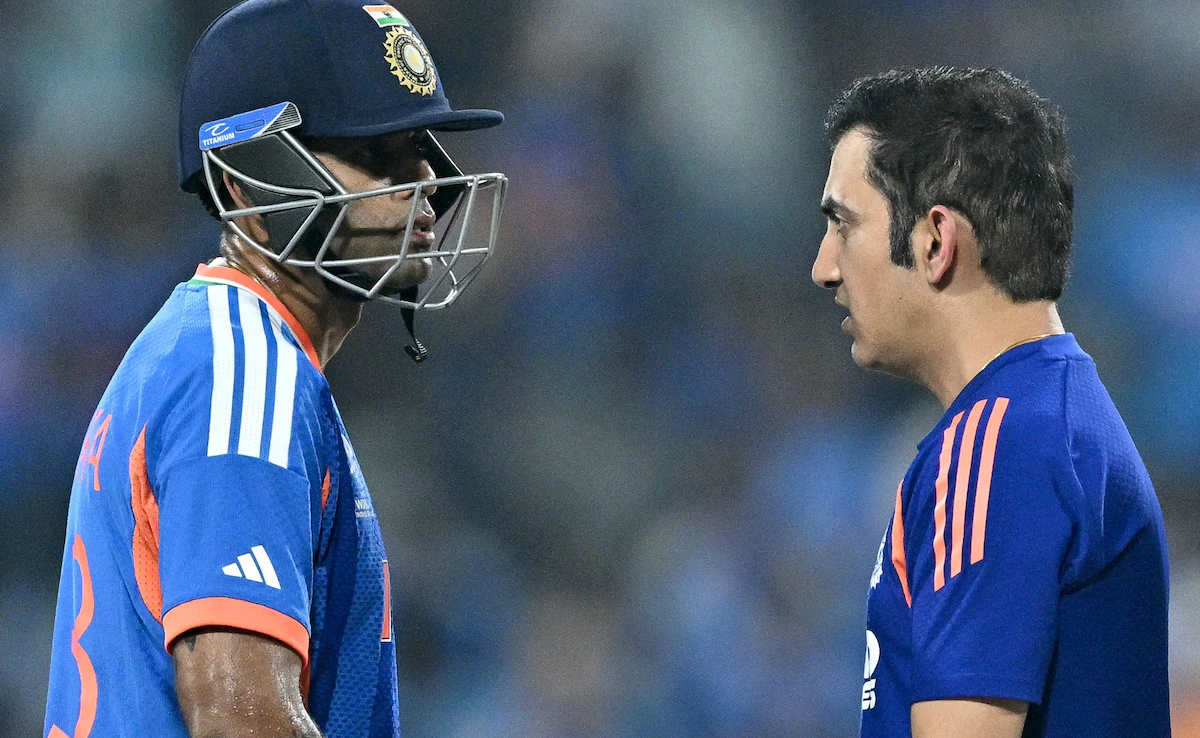
But matches are often won or lost at the toss and the selection table. When Suryakumar Yadav announced the team, revealing that India was going with an unchanged side from their previous, less-convincing outing, a collective groan echoed across the Indian cricket community. The Playing XI felt less like a carefully crafted unit designed for the Ahmedabad pitch and more like an “incomplete” jigsaw puzzle with missing pieces.
Here is why Gautam Gambhir is facing the heat.
1. The “Incomplete” XI: Breaking Down the Blunders
Gambhir is widely respected for his aggressive, no-nonsense approach to the game. However, his tenure as head coach has recently been marred by a stubborn adherence to specific matchups that often defy logic.
A. The Axar Patel Snub: Dropping the Vice-Captain
The most glaring omission from the Playing XI was Axar Patel. Sitting out a player of Axar’s caliber—who is ironically the vice-captain of the squad—was baffling. Suryakumar called it a “tactical decision,” but fans are asking: what exactly was the tactic?
- The Flawed Logic: India opted to retain Washington Sundar, presumably because South Africa has left-handers like Quinton de Kock and David Miller.
- The Reality: Axar Patel offers infinitely more control in the middle overs, is a far superior lower-order hitter, and possesses big-match temperament. Without him, India lacked a reliable spin anchor. By prioritizing a purely right-arm off-spin matchup (Sundar) over a superior, complete all-rounder (Axar), Gambhir fielded a team that lacked depth.
B. The Left-Handed Logjam at the Top
In modern T20 cricket, predictability is a death sentence. India walked into a crunch Super 8 game with three left-handers at the top of the order: Ishan Kishan, Abhishek Sharma, and Tilak Varma.
South African captain Aiden Markram read this beautifully. He opened the bowling with his own off-spin to counter the left-handers.
- The Result: Kishan was dismissed for a duck in the very first over by Markram. Abhishek Sharma, horribly short on confidence after multiple failures, fell for an ugly 15 off 12 balls to Marco Jansen. Tilak Varma, returning from a lengthy injury layoff and looking rusty, managed just 1 run off 2 balls before falling to Jansen as well.
By stacking the top order with similar player profiles, India made South Africa’s bowling plans incredibly easy to execute.
C. The Sanju Samson Dilemma
With Abhishek Sharma failing repeatedly (recording multiple ducks in the lead-up games) and the top order crying out for a right-handed presence to break the monotony, the decision to keep Sanju Samson on the bench was heavily criticized. Samson’s ability to attack spin in the powerplay was exactly what India needed to throw South Africa off their rhythm.
2. The Match Story: South Africa’s Masterclass vs. Bumrah’s Lone Fight
To truly understand how poorly India executed their game plan, we have to look at how South Africa played the same pitch.
Bumrah’s Brilliance Wasted
Jasprit Bumrah was, as always, a cheat code. He completely dismantled the top of the Proteas’ batting order. Arshdeep Singh and Bumrah reduced South Africa to 20/3 inside four overs. At that moment, India had their foot on South Africa’s throat. Bumrah finished with incredible figures of 3/15, breaking R. Ashwin’s record for the most wickets in T20 World Cup history by an Indian bowler in the process.
But what happened next exposed the soft underbelly of India’s bowling strategy once Bumrah was bowled out.
The Miller and Brevis Rescue Mission
Instead of panicking, veterans David Miller (63 off 35) and young phenomenon Dewald Brevis (45 off 29) launched a calculated counter-attack. They targeted the middle overs, completely neutralizing India’s spinners.
| Phase of Play | South Africa’s Approach | India’s Approach (During Chase) |
| Powerplay | Lost 3 early wickets but scored aggressively (20/3 to 45/3). | Complete collapse. Lost 3 wickets for 29 runs. |
| Middle Overs | Rebuilt steadily. Miller & Brevis 97-run stand. | Panic. Dube and Pandya struggled to rotate strike. |
| Death Overs | Exploded. Tristan Stubbs hit back-to-back sixes off Hardik Pandya (20th over). | Match was already dead. Folded for 111. |
When Hardik Pandya stepped up to bowl the 20th over, he was taken to the cleaners by Tristan Stubbs (44* off 24), shifting the momentum entirely in South Africa’s favor. They posted 187/7, a total that was about 30 runs above par on a pitch where the ball was gripping.
3. India’s Batting Collapse: A Case of Ego vs. Strategy
When it was India’s turn to bat, the “incomplete” nature of the team was brutally exposed. Without a solid anchor, the run-chase devolved into a series of panicked, ego-driven shots.
In the post-match presentation, Aiden Markram provided a subtle but devastating critique of India’s approach. He noted that his team realized the pitch was tricky early on, stating, “It was about finding space where we could run hard, drop the ego and take as much as we could at the back end.”
India did the exact opposite.
- Abhishek Sharma tried to blindly slog his way out of a slump, playing agricultural heaves instead of respecting the conditions.
- Suryakumar Yadav (the captain) struggled to find fluency and was caught at midwicket in the 10th over trying to force a boundary.
- By the halfway mark, India was reeling at 57/5.
Only Shivam Dube (42 off 37) showed any real fight, but the asking rate had climbed to impossible heights. Marco Jansen (4/22), Keshav Maharaj (3/24), and Corbin Bosch (2/12) dismantled the heavily hyped Indian batting lineup with terrifying ease.
4. The Pattern of Poor Planning: Gambhir’s “Transition” Excuse
The anger directed at Gautam Gambhir is not just about this single T20 loss. It is a compounding frustration. Fans vividly remember late 2025 when India was whitewashed by South Africa and New Zealand in home Test series. During those horrific red-ball defeats, Gambhir famously brushed off the criticism by blaming the “transition phase” and stating that young players need time.
However, you cannot use the “transition” excuse in the Super 8s of a World Cup at home. India came into this tournament as defending champions and the number one ranked T20 side in the world. You do not field an experimental, unbalanced XI in a knockout-style environment and expect the fans to digest it as a “learning experience.”
The fans are rightfully calling this out. Social media is flooded with comments declaring this a “reality check for Gautam Gambhir & Co.” and pointing out that the team needs to stop relying on individual miracles and start building a cohesive, tactically sound unit.
Conclusion: The Semifinal Equation and Survival
The 76-run defeat has done massive damage to India’s Net Run Rate (NRR), leaving them in a precarious position in Super 8 Group 1. The point of no return is looming.
India’s remaining Super 8 fixtures are against Zimbabwe and the West Indies. If they want to reach the semifinals and keep their dreams of a home World Cup victory alive, Gautam Gambhir and Suryakumar Yadav must swallow their pride and fix the glaring holes in this Playing XI.
They must drop the out-of-form Abhishek Sharma, bring Sanju Samson in to break the left-handed monotony, and reinstate Axar Patel to provide much-needed balance to the bowling and lower-order batting. There is no more room for “tactical” blunders; survival mode has officially begun.