




A major NASA research paper has provided fresh insight into one of science’s enduring mysteries: where Earth’s vast oceans came from. By studying ancient lunar soil samples from the Apollo missions, scientists have found that late water delivery by meteorites — long considered a chief source of Earth’s water — likely contributed only a small fraction of our planet’s total water inventory.
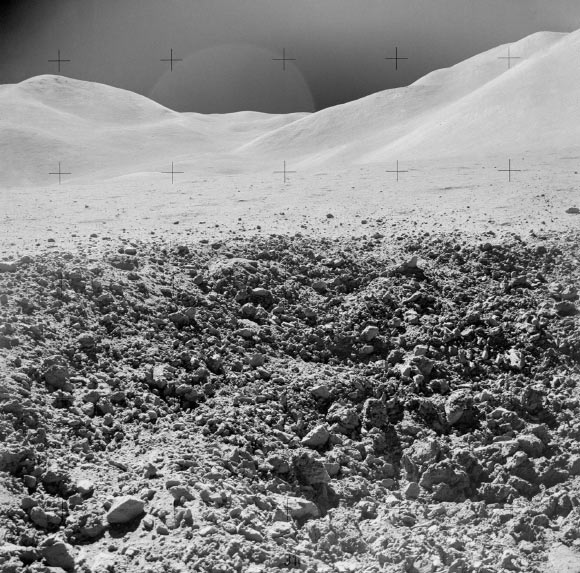
The findings, published in the Proceedings of the National Academy of Sciences, come from a detailed analysis of the Moon’s regolith — the dusty layer of soil and broken rock that covers the lunar surface. Because the Moon lacks a dynamic crust and atmosphere like Earth’s, it has preserved a multibillion-year record of impacts that have also affected our planet.
How the Study Was Done
Researchers, including Tony Gargano of NASA’s Johnson Space Center and the Lunar and Planetary Institute, used a novel oxygen isotope analysis to distinguish between material that was part of the original lunar surface and material brought by impacts. Oxygen is the most abundant element in planetary rocks, and its isotope “fingerprints” remain stable even after extreme events like meteorite impacts.
By interpreting these isotope signatures in Apollo lunar soil samples, the team was able to estimate how much water-carrying material was delivered to the Earth–Moon system over billions of years. Even after scaling up the Moon’s record by roughly 20 times to account for Earth’s larger impact rate, the total water delivered by meteorites amounts to only a small percentage of Earth’s oceans.
Challenging the Meteorite-Delivery Theory
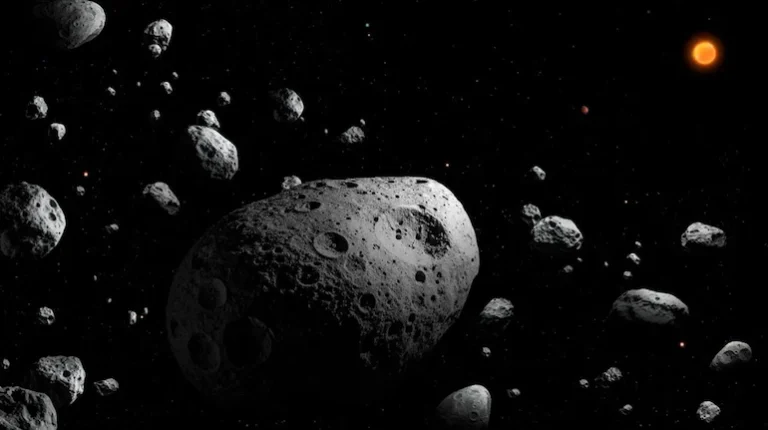
For decades, many scientists believed that a wave of water-rich asteroids and comets during the early solar system’s Late Heavy Bombardment — between about 4.1 and 3.8 billion years ago — delivered much of Earth’s water to the young planet. This idea drew support from earlier studies suggesting that some comets and certain types of asteroids contained water with isotopic compositions similar to Earth’s oceans.
However, the new NASA results indicate that even if Earth endured an intense bombardment of carbonaceous meteorites, the amount of water these bodies could have supplied was limited. According to co-author Justin Simon, the study doesn’t rule out any contribution from meteorites, but it makes it very difficult for meteorite delivery to be the dominant source of the water in Earth’s oceans.
What This Means for Earth’s Water Puzzle
If late-arriving meteorites were not the primary water suppliers, researchers must look elsewhere to explain how Earth became so water-rich:
Early Accretion Sources
One possibility is that water was present in the building blocks of the planet itself. Studies of ancient meteorites and early solar system materials suggest that some planetesimals — the small bodies that coalesced to form Earth — may have contained water from the very beginning, carrying it into the planet’s interior as it formed.
Deep Earth Sources
Another idea supported by some geochemical research is that significant amounts of water came from within Earth’s interior, released through volcanic outgassing during the planet’s early evolution. This deep water model posits that water may have been locked into minerals in Earth’s mantle and later released as surface water.
Comets and Other Bodies
Although the new study limits the contribution of meteorites, some comets and asteroids — particularly those from the outer solar system — have water with isotopic signatures similar to Earth’s oceans. These bodies may still have played a role earlier in Earth’s history, before or during planetary accretion.
Why the Moon Matters
The Moon acts as a natural archive of impact history because its surface has remained relatively unchanged for billions of years. By studying lunar samples, scientists can trace which types of objects bombarded the Earth–Moon system, what materials they carried, and how that record compares to what we observe on Earth today.
The oxygen isotope technique used in this study provides a clearer way of identifying impactor material in the lunar soil, overcoming difficulties with traditional methods that can be skewed by repeated impacts and surface reworking.
Broader Implications
This research not only reshapes our understanding of Earth’s water origins but also affects how scientists think about water on other rocky planets and moons. By better understanding where planetary water comes from — whether from initial building materials, impacts, or internal processes — researchers can refine models of planet formation and assess the potential for oceans on other worlds.
The study highlights the value of preserved extraterrestrial records, like lunar regolith, and anticipates that new samples collected by future missions (such as NASA’s Artemis program) will provide even deeper insight into the early history of water in the Earth–Moon system and beyond.
In Summary
- A new NASA study using Apollo lunar soil samples shows meteorites could only have delivered a tiny fraction of Earth’s water over the last ~4 billion years.
- High-precision oxygen isotope analysis of lunar regolith offers a clearer picture of impactor composition than older methods.
- These results challenge the idea that late meteorite bombardment was the main source of water and point researchers toward early accretion, internal processes, or other bodies as key contributors.